
Jan 3, 2026
15 mins
Bare Metal in 2026: The Backbone of Next-Generation Digital Infrastructure
The physical hardware powering today’s digital services is more important than ever. While virtual machines and containers have dominated conversations for years, a significant shift is happening. Enterprises running AI, high performing compute, machine learning workloads, high-frequency trading systems, and latency-sensitive applications are returning to dedicated servers that deliver predictable, uncompromised performance.
However, organizations face significant challenges when managing multi-cloud and hybrid environments, including fast-growing costs, reduced control, increased security risks, and compliance difficulties. These challenges highlight the need for robust infrastructure solutions that provide better visibility, control, and security.
This guide breaks down everything you need to know about bare metal infrastructure: what it is, how it fits into modern digital infrastructure, and why 2026 buying trends are accelerating its adoption across industries.
Answer first: what is bare metal in digital infrastructure?
Bare metal refers to single-tenant physical servers dedicated entirely to one customer, with no hypervisor layer sitting between the operating systems and the underlying hardware. A bare-metal server is a dedicated physical computer used by a single tenant, unlike virtualized or cloud servers that share resources among multiple users. Unlike virtual machines that share resources with other tenants on the same host, bare metal gives you direct access to 100% of the CPU/GPU cores, RAM, data storage, and I/O bandwidth. This makes it the preferred choice for databases, AI training clusters, and any application where consistent low latency matters more than elastic scale.
In modern digital infrastructure, bare metal sits alongside public or private clouds, colocation facilities, and edge computing sites. Hyperscalers like AWS, Google Cloud, and Microsoft Azure now offer bare-metal instances alongside their virtualized compute options. Specialized cloud providers and colocation operators provide dedicated servers with cloud-style provisioning through APIs and hourly billing. The result is a hybrid landscape where companies can place workloads on the infrastructure type that best matches their performance, security, and cost requirements.
Core benefits of bare metal at a glance:
Predictable performance with no noisy neighbor interference
Strong isolation for compliance and security-sensitive workloads
Hardware-level control over BIOS, firmware, and kernel tuning
Lower total cost of ownership at scale for steady-state workloads
Customization in bare metal environments allows users to fine-tune the entire stack, including the operating system, network configurations, and specific hardware components to meet precise workload requirements.
These characteristics make bare metal the anchor point for high-performance computing environments where virtualization overhead simply isn’t acceptable.

What is digital infrastructure?
Digital infrastructure is the technological foundation that supports the digital operations of businesses, governments, and society. It is the combined layer of physical assets, such as data centers, fiber networks, 5G towers, bare metal servers, switches, and storage arrays, and logical assets like virtualization platforms, container orchestration systems, and security controls that enable digital services to operate. These foundational and structural elements form the basis for cloud-based services and operational governance, allowing businesses to connect with customers, process transactions, store data, and deliver applications across the public internet and private networks.
Businesses rely on digital infrastructure to work efficiently and compete in increasingly connected global markets.
This infrastructure is inherently hybrid and distributed. The 2010s saw rapid adoption of cloud platforms that abstracted away physical hardware. After 2015, hyperscale data centers expanded globally to meet demand. From 2019 onward, 5G networks began spreading, enabling new edge computing use cases. Today, organizations typically operate across on-premises racks, third-party colocation sites, public cloud regions, and edge locations...and more, all working together through sophisticated cloud connectivity and network fabrics. Digital infrastructure can scale to meet demand spikes and enable faster deployment times. It also requires less maintenance and eliminates downtime to perform upgrades.
How bare metal underpins the digital infrastructure stack:
Runs high-performance databases that can’t tolerate virtualization overhead
Powers AI/ML training clusters requiring direct GPU and accelerator access
Hosts low-latency trading engines where microseconds impact profitability
Supports real-time analytics workloads with predictable I/O throughput
Enables secure, isolated environments for regulated industry applications
Optimizing digital infrastructure can enhance the experience for employees, partners, and customers.
Modern digital infrastructure isn’t about choosing between physical and virtual, it’s about placing each workload on the right layer for its specific requirements.
What are bare-metal servers?
A bare metal server is a physical server allocated exclusively to a single tenant. Unlike virtual machines running on shared hardware under a hypervisor, bare metal provides direct access to all hardware resources without any abstraction layer consuming cycles or introducing latency.
Core characteristics of bare-metal servers:
Feature | Description |
|---|---|
Dedicated CPU/ GPU | All cores and threads reserved for your workloads |
Exclusive RAM | No memory contention with other tenants |
Direct storage access | NVMe SSDs with full IOPS available |
No hypervisor | Operating systems run directly on hardware |
Full OS control | Choose your kernel, drivers, and configurations |
Hardware access | BIOS/UEFI settings, firmware updates under your control |
The “noisy neighbor” problem that plagues multi-tenant environments disappears entirely with bare metal. In virtualized clouds, another customer’s CPU-intensive process can starve your application of resources. On dedicated hardware, you control everything, and performance remains consistent regardless of what other customers on the platform are doing.
By the early 2020s, providers began offering bare metal servers with cloud-style provisioning. You can now deploy a physical server through an API, pay by the hour, and decommission it when the project ends. This BMaaS (Bare-Metal-as-a-Service) model combines the control of traditional dedicated hosting with the convenience users expect from public cloud.
Typical bare-metal configurations in 2024–2026:
AMD EPYC or Intel Xeon Scalable processors (4th/5th generation)
512GB to 2TB of DDR5 RAM
Multiple NVMe SSDs in RAID configurations
25/100/400 Gbps networking options
Optional GPU accelerators (NVIDIA H100, AMD Instinct)
Bare metal vs. virtualized cloud infrastructure
Virtualization became dominant in the 2000s and 2010s because it dramatically improved hardware utilization. Technologies like VMware, Xen, KVM, and Hyper-V allowed multiple isolated environments to share a single physical server. For many workloads, this trade-off made sense, you gained flexibility and density at the cost of some performance overhead.
But not all workloads benefit from virtualization. Here’s how bare metal and virtualized cloud compare across key dimensions:
Dimension | Bare Metal | Virtualized Cloud |
|---|---|---|
Performance | Consistent, no hypervisor overhead | Variable, depends on host load |
Isolation | Physical separation, single-tenant | Logical separation, multi-tenant |
Security | Reduced attack surface, hardware controls | Hypervisor adds complexity |
Elasticity | Slower to provision (minutes to hours) | Rapid scaling (seconds) |
Operational complexity | Customer manages OS and below | Provider manages more layers |
Cost profile | Lower unit cost at scale | Pay-as-you-go flexibility |
Scenarios where bare metal typically wins:
High-frequency trading platforms requiring microsecond latency
Large-scale relational databases with intensive I/O patterns
Real-time gaming backends serving millions of concurrent users
GPU-based AI training where PCIe bandwidth matters
Workloads with strict compliance requirements for physical isolation
Scenarios where virtualized cloud makes more sense:
Burst workloads with unpredictable demand patterns
Early-stage startups needing to experiment quickly
Global distribution across dozens of cloud regions
Applications where elasticity matters more than raw performance
Major cloud providers recognized the demand gap and introduced bare-metal instances between 2017 and 2020. AWS Bare Metal, Google Cloud Sole-Tenant Nodes, and Azure Dedicated Hosts give enterprises the option to run workloads on dedicated hardware while staying within familiar cloud environments.
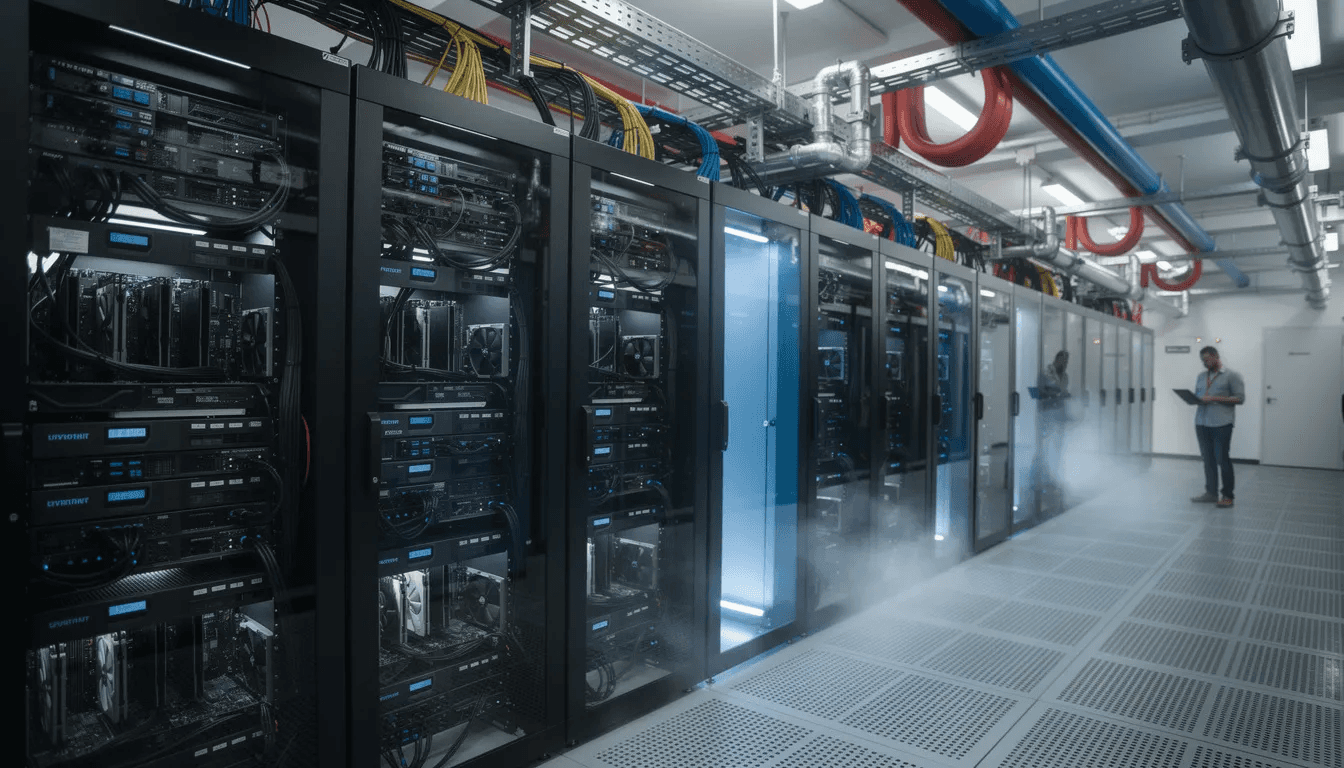
Bare-metal cloud and BMaaS (Bare-Metal-as-a-Service)
Bare-metal cloud refers to consuming physical servers through cloud-style interfaces, like APIs, web portals, and automation tools, rather than traditional procurement cycles. BMaaS providers handle the lifecycle management while you retain full control over the server itself once provisioned.
Key capabilities of BMaaS platforms:
Automated discovery and inventory of physical hardware
PXE-based provisioning with customizable OS images
Firmware and BIOS management at scale
Monitoring, alerting, and health checks
Secure decommissioning with drive wiping
How BMaaS differs from traditional dedicated hosting:
Provisioning in minutes or hours instead of days or weeks
Hourly or monthly billing instead of annual contracts
Self-service automation instead of support tickets
API-driven operations instead of manual processes
How BMaaS differs from composable disaggregated infrastructure:
Composable infrastructure uses specialized fabrics to dynamically attach pools of compute, storage, and accelerators on demand. It requires significant architectural changes. BMaaS typically uses standard servers with optional external storage connections (iSCSI, NVMe-oF) and integrates more easily into existing environments.
Real-world BMaaS use cases in 2024–2026:
Global SaaS providers building private clouds for performance-critical tiers
Telecom operators hosting 5G core network functions on dedicated hardware
AI research labs running GPU clusters with bare-metal provisioning frameworks
Financial institutions deploying trading systems with deterministic performance
Healthcare companies processing sensitive patient data on isolated infrastructure
Use of bare metal in edge computing
Edge computing brings processing power closer to users, devices, and data sources. Rather than sending every request to a centralized data center, edge sites handle latency-sensitive operations locally—and bare metal often powers these distributed nodes.
Why bare metal suits edge deployments:
Minimal overhead means more usable compute per watt
Consistent performance for real-time decision-making
Simplified software stack without hypervisor complexity
Direct hardware access for specialized network functions
Concrete edge computing examples:
Retail analytics: In-store bare-metal servers process video feeds for inventory tracking and customer behavior analysis without round-trips to remote data centers
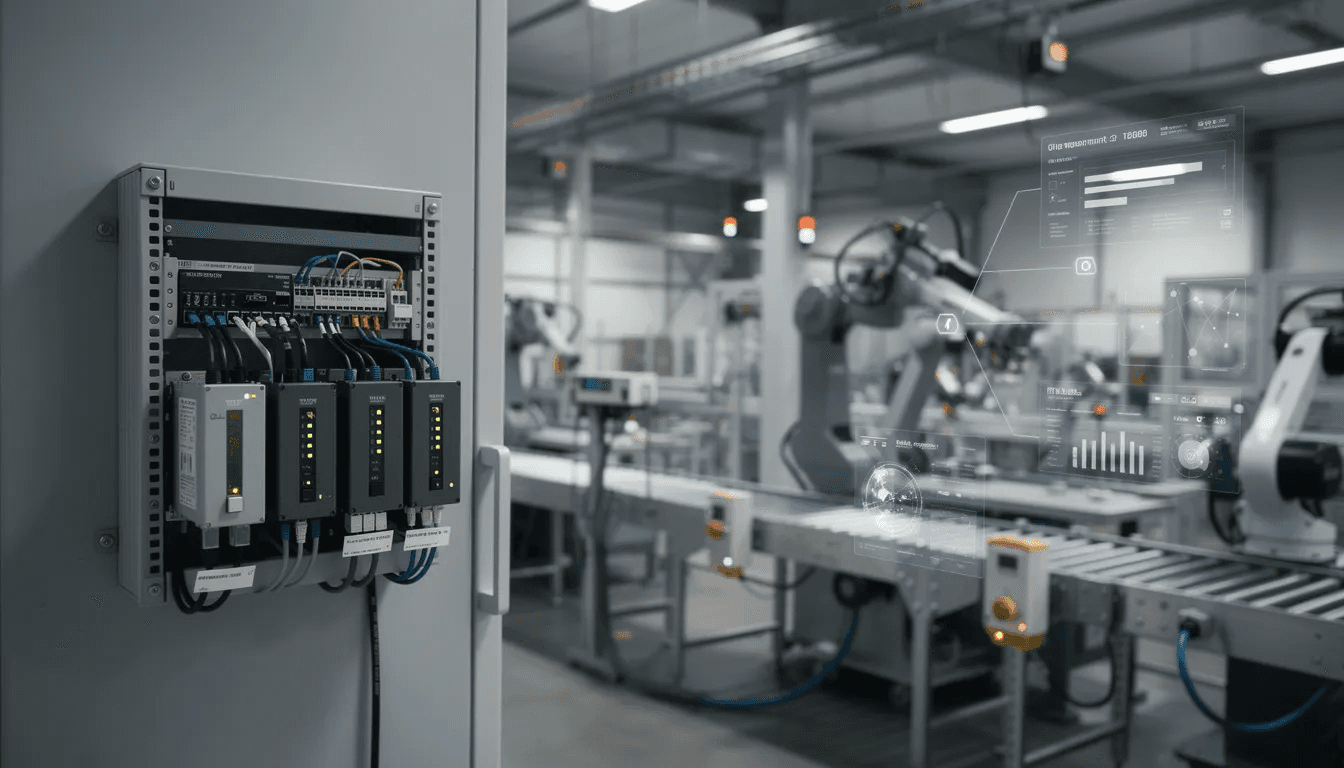
Industrial IoT: Manufacturing plants run OT workloads on hardened bare-metal nodes connected to sensors and PLCs
5G network edges: Telecom operators deploy bare metal at base station sites to host mobile edge computing (MEC) functions
Content delivery: CDN providers place bare-metal caches near population centers to reduce internet traffic latency
The role of automation at the edge:
Managing even thousands of small bare-metal servers across distributed locations requires robust automation. BMaaS platforms enable remote provisioning, patching, and replacement without on-site engineers. Automation and BMaaS allow IT teams to focus on core responsibilities such as application development, testing, and security, rather than spending time on infrastructure management. This operational model has evolved significantly from the early days of physical on-prem servers in the 1990s–2000s, through centralized shared hosting in the 2010s, to today’s software-driven distributed edge infrastructure.
Security, compliance, and control on bare metal
Enterprises in regulated sectors—finance, healthcare, government—often favor bare metal because it simplifies security postures and compliance audits. When you’re the only tenant on a physical server, entire categories of multi-tenant risks disappear.
Security advantages of bare metal:
Hardware isolation: No shared hypervisor means no cross-tenant attack vectors
Reduced attack surface: Fewer software layers to patch and secure
Deterministic placement: Data stays on specific hardware for sovereignty requirements
Firmware control: Manage CPU microcode, BIOS settings, and Secure Boot configurations
TPM integration: Hardware-based key storage and attestation
Compliance frameworks where bare metal helps:
Framework | Bare Metal Benefit |
|---|---|
PCI DSS | Physical isolation for cardholder data environments |
HIPAA | Single-tenant systems for protected health information |
GDPR | Data residency control with known physical locations |
FedRAMP | Hardware-level controls for government workloads |
Operational controls available on bare metal:
Choose specific CPU microcode levels to address vulnerabilities
Configure BIOS/UEFI settings without provider involvement
Deploy host-based intrusion detection without multi-tenant limitations
Implement custom kernel hardening specific to your threat model
Control physical access policies at colocation facilities
With bare metal, you gain control—but also responsibility. Patching, secure configuration, and decommissioning (drive wiping, encryption key destruction) fall entirely on your operations team.
Performance and workload patterns suited to bare metal
Bare metal is typically chosen for performance-sensitive, resource-intensive, or steady-state workloads where the overhead of virtualization creates measurable problems. If your application needs every cycle the CPU can deliver, bare metal is worth evaluating.
Workload types that benefit from bare metal:
High-performance databases: PostgreSQL, Oracle, and SQL Server deployments with intensive I/O patterns where IOPS consistency matters
Large in-memory caches: Redis or Memcached clusters requiring maximum available RAM without hypervisor overhead
AI/ML training clusters: GPU-accelerated workloads where PCIe bandwidth to accelerators directly impacts training time
Latency-sensitive trading systems: Financial applications where microseconds affect profitability
High-throughput storage gateways: Systems moving massive data volumes where network and storage I/O can’t be shared
3D rendering farms: Compute-heavy graphics workloads that scale linearly with available resources
Performance considerations for bare metal deployments:
Virtualization overhead elimination: CPU-bound workloads may see 5-15% improvement
PCIe bandwidth: Direct GPU and NVMe access without virtualization bottlenecks
NUMA optimization: Fine-tune memory locality for multi-socket systems
CPU pinning: Dedicate specific cores to specific processes for deterministic latency
Interrupt affinity: Control which cores handle network and storage interrupts
Modern benchmark suites like SPEC, TPC, and MLPerf can help quantify the difference for your specific applications. When evaluating 4th-gen Intel Xeon Scalable or AMD EPYC “Genoa” systems, test with realistic workload patterns rather than synthetic benchmarks alone.
Artificial intelligence and operating systems on bare metal
Artificial intelligence (AI) and machine learning (ML) are transforming the way businesses leverage their digital infrastructure, and bare-metal servers are at the heart of this evolution. By providing direct access to physical hardware, bare-metal environments eliminate the performance bottlenecks and unpredictable latency often associated with virtualized platforms. This is especially critical for AI and ML workloads, where low latency and high throughput are essential for training complex models and processing vast datasets.
Operating systems deployed on bare-metal servers can be finely tuned to support the unique requirements of AI and ML applications. Companies can optimize kernel parameters, drivers, and system resources to maximize the performance of GPUs and accelerators, ensuring that every bit of hardware is dedicated to the task at hand. This level of control is vital for businesses aiming to improve efficiency and maintain a competitive edge in data-driven industries.
The rise of edge computing further amplifies the importance of bare metal for AI and ML. As mobile data and internet traffic surge, organizations are deploying bare-metal servers at the edge to process information in real time—close to where it’s generated. This reduces reliance on traditional networks and public cloud services, enabling faster decision-making and supporting latency-sensitive services such as autonomous vehicles, smart manufacturing, and real-time analytics.
By leveraging AI and ML on bare-metal infrastructure, companies can manage and analyze massive volumes of data with greater speed and accuracy. This not only enhances their ability to deliver critical digital services but also supports the scalability and flexibility required in modern cloud connectivity strategies. As digital technologies continue to advance, the combination of bare-metal performance and customizable operating systems will remain a cornerstone of high-performance, future-ready digital infrastructure.
What is digital infrastructure buying in 2026? Top trends shaping bare-metal adoption
By 2026, digital infrastructure spending is being driven by insatiable AI/ML compute demand, data-intensive analytics requirements, 5G and early 6G network rollouts, corporate sustainability mandates, and stricter data-sovereignty regulations across jurisdictions. Decision-makers are no longer just choosing between cloud and dedicated hardware, they’re blending hyperscale cloud resources with bare-metal clusters in colocation and edge sites to balance cost predictability, performance guarantees, and regulatory control.
The pattern emerging in 2026 shows enterprises moving beyond pure VM-based IaaS strategies toward mixed architectures where bare metal anchors performance-critical tiers. AI training clusters require dedicated GPU servers without virtualization overhead. Real-time analytics demand consistent latency. Regulated workloads need physical isolation. This convergence is accelerating bare-metal adoption even among organizations that previously went all-in on public cloud.
Key 2026 trends driving bare-metal investment:
Generative AI infrastructure: GPU-rich bare-metal clusters for training and inference, often achieving 20-30% better efficiency than virtualized alternatives
Multi-cloud and sovereign cloud requirements: Regulatory pressure to keep data within specific jurisdictions on controlled hardware
Private 5G and edge expansion: Manufacturing, logistics, and retail deploying bare metal at edge sites for real-time operations
Sustainability goals: Organizations targeting specific PUE metrics and renewable energy contracts, optimizing workload placement
Automation-first operations: GitOps, infrastructure as code, and BMaaS enabling cloud-like agility for physical servers
Cloud repatriation: Enterprises moving steady-state workloads back to dedicated servers for cost predictability
Hybrid IaaS stacks: Mixing VMs, containers, and bare metal within unified management planes
Industry analysis suggests 40-50% of enterprise workloads needing raw compute power are candidates for bare metal, particularly as 5G/6G edge deployments amplify low-latency requirements.
Digital infrastructure vs. on-prem: where bare metal fits
Traditional on-premises data centers, whether they are fully owned and managed by the enterprise or not, served organizations for decades. Modern digital infrastructure has evolved beyond this single model, creating a spectrum where bare metal appears in multiple contexts with different operational and financial characteristics.
Where bare-metal servers can reside:
Location | Characteristics | Best For |
|---|---|---|
On-premises | Full control, CapEx model, internal staff | Legacy systems, maximum control |
Colocation | Third-party facility, your hardware, OpEx + CapEx | Hybrid architectures, disaster recovery |
Bare-metal cloud | Provider hardware, cloud consumption, OpEx | Flexibility, reduced operational burden |
Edge sites | Distributed, often automated via BMaaS | Latency-sensitive, distributed apps |
The shift from 2020 to 2025:
Organizations increasingly moved from purely on-prem hardware toward hybrid models combining bare metal with managed cloud services. The driver wasn’t abandoning physical control—it was gaining flexibility while retaining it where needed.
Operational and financial differences:
On-premises: High CapEx, long procurement cycles, full depreciation, internal maintenance teams
Colocation bare metal: Mix of CapEx (hardware) and OpEx (space/power), provider manages facility
BMaaS/bare-metal cloud: Pure OpEx, rapid provisioning, provider manages hardware lifecycle
Sector-specific example scenarios:
Financial services: For example, core banking ledgers on regulated bare-metal environments in controlled colocation; customer-facing mobile apps in public cloud
Manufacturing: For example, OT and process control workloads on on-site bare metal with edge connectivity; business systems in hybrid cloud
Healthcare: For example, patient data processing on HIPAA-compliant bare metal; administrative systems in cloud-based platforms
In hybrid and multi-cloud environments, organizations often use cloud storage as part of their hybrid strategies, storing large datasets in the cloud while running compute-intensive workloads on bare metal. However, accessing cloud storage over the public internet can introduce latency and reliability issues. Private network solutions that extend to the cloud offer improved performance and security for accessing cloud storage.
The decision isn’t binary. Modern digital infrastructure strategies place workloads based on their specific requirements for performance, security, compliance, and cost—and bare metal remains an essential option across all deployment models.
The evolving data center: from racks to software-driven bare metal
The data center has transformed dramatically over three decades. What began as enterprise server rooms with manually configured systems has evolved into a globally distributed fabric of physical and virtual resources managed through software.
Key milestones in data center evolution:
Era | Timeframe | Characteristics |
|---|---|---|
Single-tenant server rooms | 1990s | Physical servers, manual operations, limited scale |
Virtualized enterprise DCs | 2005–2015 | VMware/hypervisor adoption, improved utilization |
Hyperscale and public cloud | 2010–2020 | AWS, Azure, GCP growth; abstraction of hardware |
Bare-metal cloud emergence | 2017–2020 | Dedicated hardware with cloud provisioning |
Software-defined infrastructure | 2020–2026 | IaC, GitOps, unified management across layers |
The software-defined shift:
Bare metal is now managed through the same DevOps and GitOps pipelines as virtual machines and containers. Terraform provisions servers. Ansible configures them. Kubernetes orchestrates containerized workloads on top. The physical server has become a programmable resource rather than a manually managed asset.
Current state (mid-2020s):
Industry analysts report that a majority of enterprise infrastructure strategies now mix on-prem systems, colocation facilities, public cloud regions, and edge locations. The “data center” is no longer a single building—it’s an interconnected fabric with bare metal providing high-performance anchor points where dedicated resources deliver advantages that shared infrastructure cannot match.
The evolution continues. New standards in remote access, automation, and multi cloud environments are making bare metal as agile as virtual infrastructure while retaining its performance advantages.
Digital infrastructure for business success
A robust digital infrastructure is the foundation upon which modern businesses build their operations, drive innovation, and deliver exceptional customer experiences. In today’s fast-paced market, companies must ensure their infrastructure is designed for flexibility, scalability, and security, enabling them to adapt quickly to changing demands and new technologies.
Central to this strategy is cloud connectivity, which allows businesses to seamlessly integrate public cloud, private cloud, and hybrid cloud environments. By leveraging multi cloud environments, organizations can optimize data storage, balance workloads, and ensure the right connectivity for every application. This flexibility empowers companies to scale resources on demand, manage access efficiently, and maintain high levels of performance across all digital services.
Security and data protection are also critical components of digital infrastructure. With the right controls in place, businesses can enable secure remote access, protect sensitive information, and comply with regulatory requirements, whether operating in the public cloud or across hybrid cloud models. This not only safeguards business operations but also builds trust with customers and partners.
Investing in digital infrastructure enables companies to improve collaboration, streamline processes, and respond rapidly to market opportunities. By focusing on the ability to manage, scale, and secure their resources, businesses can reduce costs, enhance operational efficiency, and unlock new avenues for growth. Ultimately, a well-architected digital infrastructure strategy is essential for companies seeking to stay ahead of the competition and achieve long-term business success.
Planning a bare-metal strategy within your digital infrastructure
Choosing bare metal is a strategic design decision that touches architecture, finance, security, and operations. Getting it right requires systematic evaluation rather than assumptions about where dedicated hardware adds value.
Key planning steps:
Assess workload requirements
Identify applications that truly need dedicated hardware
Measure current performance bottlenecks in virtualized environments
Quantify latency sensitivity and I/O patterns
Map regulatory requirements
Document data residency and sovereignty constraints
Identify compliance frameworks requiring physical isolation
Evaluate audit requirements for hardware-level controls
Compare TCO over 3-5 years
Model bare metal vs. virtualized cloud costs for steady-state workloads
Include operational costs: staffing, patching, maintenance
Factor in performance differences affecting application capacity
Evaluate deployment models
BMaaS for flexibility and reduced operational burden
Colocation for control with facility outsourcing
On-premises for maximum control and existing investments
Integration considerations:
Align bare metal with Kubernetes for container orchestration
Connect to multi cloud environments through software-defined networking
Design observability stacks covering both physical and virtual layers
Implement security controls consistent across all infrastructure types
Suggested timeline:
2025: Pilot a bare-metal cluster for a specific high-performance workload
2026: Expand to regional colocation sites based on measured results
2027+: Refine hybrid architecture as AI, edge, and connectivity requirements evolve
Looking ahead:
As artificial intelligence workloads grow, edge computing expands, and digital technologies continue transforming industries, bare metal will remain critical infrastructure for organizations that need to improve efficiency, maintain control, and deliver consistent performance. The key is treating bare metal not as an alternative to cloud, but as a complementary layer within a comprehensive digital infrastructure strategy.
The organizations that get this right will be those that match workloads to infrastructure based on concrete requirements, not ideology about cloud versus physical. Start by auditing your most demanding applications, mapping your compliance obligations, and building the business case for dedicated hardware where it genuinely delivers advantages.
Best Place to Buy Bare Metals: Inflect Digital Infrastructure Markektplace
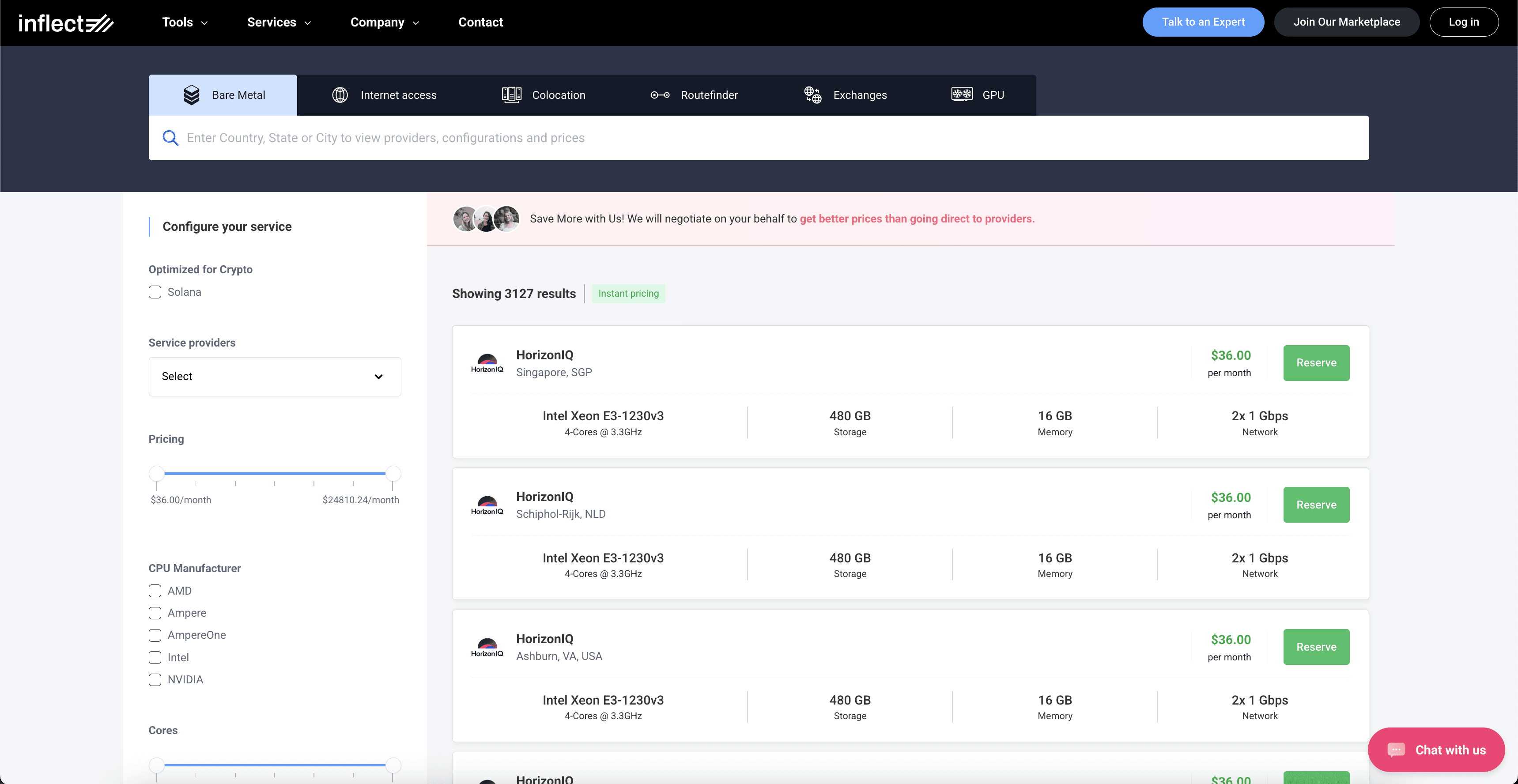
Inflect offers buyers to easily compare top service providers with pricing side-by-side on the Inflect Digital Infrastructure Marketplace. It is the best platform for buyers to research and evaluate different solutions, configurations, pricing and providers based on their needs and requirements.
Top bare metal service providers ,that are popular among buyers, on Inflect Digital infrastructure Marketplace are: Hydra Host, ColoCrossing, HorizonIQ, Limestone, Latitude, PhoenixNap, Enzu, VULTR...and so much more. All with different expertises, for instance: AI, HPC workloads, BlockChain, Web3...etc. If buyers don't know which bare metal service provider is the best for their case, or looking for budget friendly options, Inflect offers no-cost bare metal expert advisory to help buyers get the right solution at the right price.
Key takeaways
Bare metal provides single-tenant physical servers with no virtualization overhead—ideal for performance-sensitive, compliance-driven, and resource-intensive workloads
Modern digital infrastructure is hybrid: on-prem, colocation, public cloud, and edge sites working together with bare metal anchoring high-performance tiers
BMaaS brings cloud-style provisioning to dedicated hardware, combining control with operational convenience
2026 trends—AI/ML demand, edge expansion, sustainability mandates, and data sovereignty—are accelerating bare-metal adoption
Planning a bare-metal strategy requires evaluating workload requirements, regulatory constraints, and TCO across deployment models
Inflect Digital Infrastructure Marketplace is the best place to research, compare and buy bare metal with pricing ready and 0 cost expert advisory
The future of digital infrastructure isn’t about choosing sides. It’s about placing the right workloads on the right resources—and bare metal remains an essential option for the applications that demand it most.
About the Author

Chanyu Kuo
Director of Marketing at Inflect
Chanyu is a creative and data-driven marketing leader with over 10 years of experience, especially in the tech and cloud industry, helping businesses establish strong digital presence, drive growth, and stand out from the competition. Chanyu holds an MS in Marketing from the University of Strathclyde and specializes in effective content marketing, lead generation, and strategic digital growth in the digital infrastructure space.
Contact: